Hello! My name is Oscar
, and I have been programming since I was 14 years old. In 2008, I started working as a fullstack developer
, and to this day it remains both my vocation and one of the things I am most passionate about.
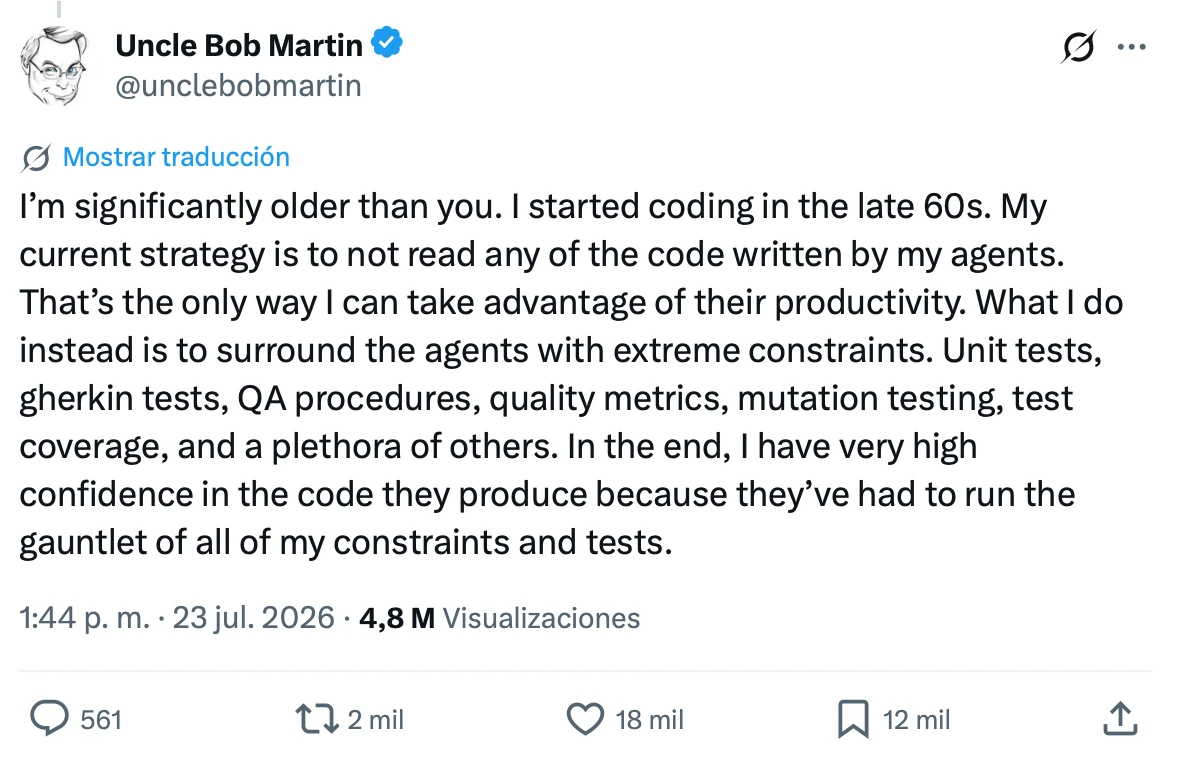
A week ago, a tweet by Robert C. Martin went viral in which he said that he no longer reviewed the code generated by his agents in order to improve his productivity.
Robert C. Martin, better known as “Uncle Bob”, is an influential software engineer who popularized Clean Code and the SOLID principles in the 2000s.
In this tweet, Martin explained that he no longer reviews the code produced by AI line by line, since he controls what is generated through unit tests, QA procedures, quality metrics, and other measures that he describes as “extreme.”
I believe that when such an influential figure in the programming world makes a statement like this, it is a good opportunity to reflect on how we are currently developing software.
I have been generating almost all my code with AI for a little over a year. Before that, however, I spent a great deal of time reviewing and understanding the generated code, until I realized that many errors were caused by the lack of constraints and by the way I was constructing my prompts.
I therefore focused on learning how to formulate more effective prompts, breaking the work down into small tasks whose results had to be verified before moving forward.
I also began applying architectural constraints that I designed myself and that would remain in place throughout the project.
Over time, I also introduced automated tests to verify that the business logic had been implemented correctly.
In this way, although it may sound sad to those of us who learned to program with a strong focus on creating clean code, the emphasis has shifted towards how we interact with AI.
It is not that Clean Code has died; only the way we generate it has changed.
Tags:
Clean Code
IA
Prompt engineering
Software architecture
Web


 Spanish